
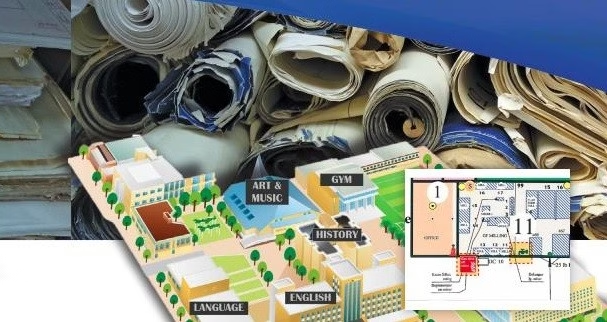
Facilities Management; Creating Structure from Chaos!
Facility Management has the objective to coordinate demand and supply facilities and services within public and private organizations. This process encompasses multiple disciplines to ensure the functionality of a built environment by integrating people, place, process and technology. Examples are real estate property, buildings, technical infrastructure (HVAC, IT Services, Lighting, and AV), transportation, furniture, and other user vertical specific equipment and appliances.
THERE ARE SEVERAL CORE COMPETENCIES OF FACILITY MANAGEMENT
- Communication, Emergency Preparedness and Business Continuity, Environmental Stewardship and Sustainability, Finance and Business.
- Human Factors, Leadership and Strategy, Operations, Maintenance and Project Management, Real Estate and Property Management, Technology.
The role of a modern Facilities Manager is overwhelming and trying to manage the necessary information to support Health and Safety, Fire Safety, Security and Maintenance Operations alone is a daunting task. But, in today’s environment they also are required to handle Cleaning Services, Business Continuity and Space Allocation.
With an FM’s Number One priority being safety (keeping people alive and safe), the real question is how can you have all the information required current and available “Real Time”?
Here is a sampling of the information required to perform these tasks and the importance of having Immediate, Real Time Access, to these Documents from Anywhere.
- Fire Safety: One of the highest risk to loss of life, and the potential to damage or shut down a business. Maintenance, inspection and testing for all fire safety systems, keeping records and certificates of compliance.
- Security: Protection of employees and the business, in particular a security system.
- Maintenance, testing and inspections: Schedules along with warranty information is required to ensure that the facility is operating safely and efficiently, to maximize the life of equipment and reduce the risk of failure.
- Operational: Or the day-to-day running of the building. Immediate response is required in many of the activities involving facility reports and escalation procedures, and instant access to these documents is critical.
- Business continuity planning: All organizations should have a continuity plan so in the event of a fire or major failure the business can recover quickly. It may be that the staff move to another site that has been set up to model the existing operation. The question is, what good is a continuity plan if you are unable to access it, or needing to go to another site to get the information.
- Space allocation and changes: In many organizations, office layouts are subject to frequent changes (Improvements). These moves need to meet compliance and statutory requirements related to office layouts. Records need to be kept and easily accessible in the case of an emergency, failure or audit.
A recent survey on the state of Facility Management has some interesting responses about how outdated technology is increasing inefficiencies and decreasing productivity for Facility Managers, here are just a few:
- FM’s average over 600 hours a year on admin tasks outside their core job function.
- 75% of FM’s believe their current technology is outdated or obsolete.
- 59% of FM’s believe that internal IT polices hurt their productivity.
- 91% of FM’s would like better mobile capabilities for information access.
Now, let’s talk about a way to Decrease Costs, Increase Security and allow for Immediate Access to all Critical Information by Creating Structure from Chaos. A few simple questions to start:
- Are all of your facility documents in one location?
- Do you ever share paper plans and never get them back or do they ever get misfiled?
- Do you have current As-Builts updated with all your TIs?
- Is your Emergency Management / Continuity plan linked to each building?
- Do you have instant access to your OSHA, EPA, Environmental Studies and Inspection records for each building?
- In case of emergency, could you find shutoff valve documents or Emergency Contacts within seconds?
- Are your O&Ms, Equipment Lists and Warranties linked to the drawings?
- Are your documents accessible remotely?
- Is sharing these documents easy?
How much easier life would be having all your facilities documents literally at your fingertips?
- Up-to-date & Organized
- Stored digitally in one place and available anytime, from anywhere
- Linked to all other relevant documents
- Accessible by anyone you give permission via a simple touch-based dashboard that requires no special software or training
- Tap, Swipe & Pinch access
- Automatic two-way syncing so you always have access to the most up-to-date documents
When searching for a vendor to help you in this process you need to look for one that offers a Facilities Information Management Dashboard. This centralizes your facilities information for instant retrieval of all your assets, records, and documents—on a digital dashboard —including buildings, plants, exterior areas, maintenance logs & equipment lists, warranties, operation & maintenance manuals, inspection reports & audits, emergency procedures, contacts and life safety plans.
A strong Dashboard offers:
- Quick access to all your latest information from your PC, tablet, or iOS device
- Document the accumulated knowledge and expertise of your team
- Increase responsiveness to regulatory inquiries or emergency responders
- Ensure a plan or critical document never walks away again
- Primary and Sub Dashboards. Access all document categories from your Primary Dashboard, and enter sub categories with Sub Dashboards
- As-Built Linking, Tennant Improvement (TI’s)
- Specs and O&M’s Emergency & Life Safety Plans, with linked legend items, tagged pictures, fire protection systems, and MEP equipment instantly.
- Also access Continuity Plans, Environmental Studies, and Inspection Reports.
Look for a vendor that offers a turn-key solution that links all your information in one easy to use dashboard that connects each building, no matter the file type (pdf, jpeg, MS Office, even maps and websites).
Look for an industry specialist with experience in managing documents and information to facilitate better communication in the design and building trades and a unique perspective on creating efficient methods of document control for the built environment.
They need to be able to single source all work and have in depth experience in converting paper documents of all kinds and sizes to digital files, organizing and incorporated these documents with current electronic files into a single, simple-to-use graphical interface. This includes documents from virtually any source.
This information needs to be available to you anytime and anywhere so I would recommend it be deliverable to you via a secure cloud and mobile-enabled dashboard providing a portable and comprehensive information system that will make finding and using your information quick and easy, from any location.
Simply put, Facilities Information Management (FIM) enhances workflow efficiency and team productivity. With tap/swipe/pinch simplicity on a mobile device, or point-and-click familiarity on a computer, owner-operators of any asset can easily deploy a linked and customized library of operating documents that are critical to the system, building, and to its inhabitant’s health and safety.
“An Investment in Knowledge always pays the Best Interest” – Benjamin Franklin

Thomas Ripple
New Business Development Executive that Leads, Educates & Motivates with Passion, Principal & Purpose.


