

Healthcare M&A: Why Information Management Should Be a Priority Before the Deal Closes
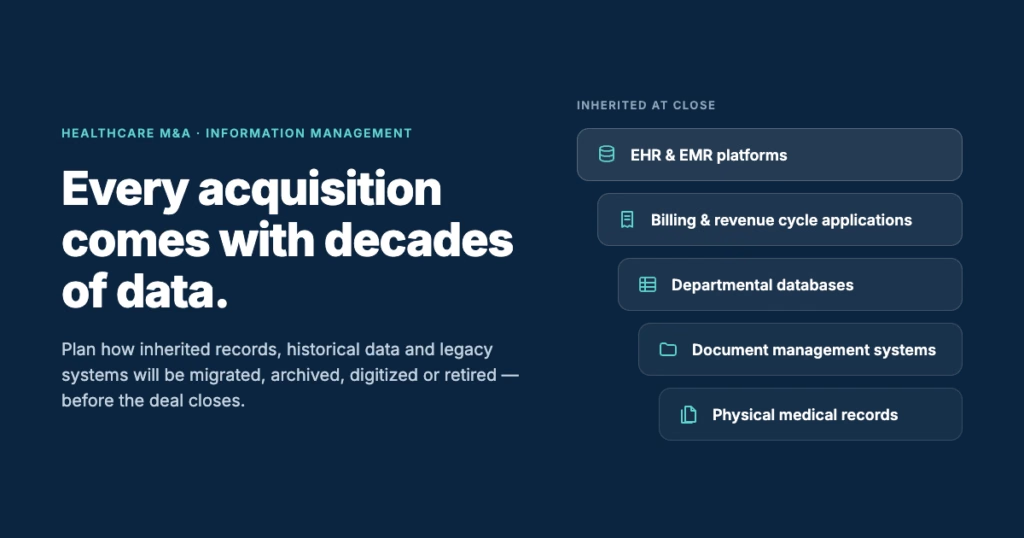
When healthcare organizations pursue mergers and acquisitions (M&A), much of the initial focus naturally centers on financial performance, operational efficiencies, organizational alignment, patient services, and opportunities for growth.
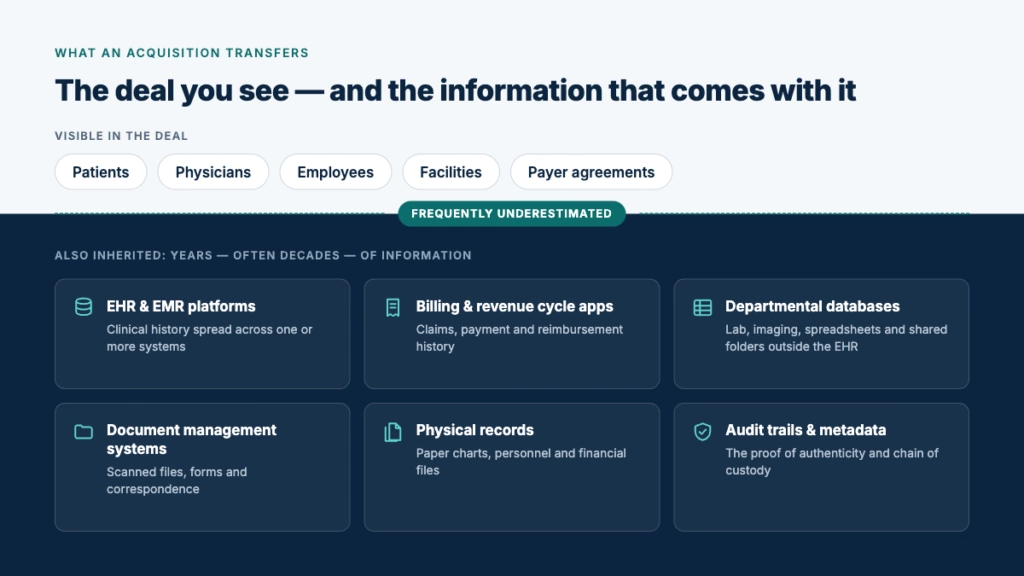
However, one of the most significant and frequently underestimated components of a healthcare transaction is the management of existing records, historical data, and legacy information systems.
When one healthcare organization acquires or merges with another, it inherits far more than patients, physicians, employees, facilities, and payer agreements. It also assumes responsibility for years, and potentially decades, of clinical, financial, administrative, and operational information.
This information may reside across multiple electronic health record (EHR) systems, electronic medical record (EMR) platforms, billing applications, departmental databases, physical medical records, document management systems, and other information repositories.
Determining how this information will be managed, preserved, protected, and made available following the transaction should be a fundamental component of the M&A planning process—not an afterthought.
Information Management Is More Than a Technology Transition
Healthcare mergers and acquisitions often involve consolidating technology platforms and standardizing systems across the newly combined organization. While implementing a common EHR or enterprise platform can provide significant long-term benefits, migrating information to a new system does not, by itself, address the full scope of information management responsibilities.
Healthcare organizations must make several critical decisions:
- What information should be migrated into the organization’s go-forward systems?
- What historical information should be preserved in a secure, searchable archive?
- What physical records need to be retained, digitized, or otherwise managed?
- What information is eligible for compliant destruction?
- Which legacy applications can be safely decommissioned?
- How will authorized individuals retrieve historical information after the transition?
These decisions have implications that extend well beyond information technology. They directly affect patient care, regulatory compliance, revenue cycle operations, legal risk, cybersecurity, and long-term operating expenses.
A comprehensive information management strategy recognizes that data migration, document digitization, archiving, retention, and system decommissioning are complementary processes rather than competing initiatives.
The Hidden Costs of Maintaining Legacy Systems
One of the anticipated benefits of healthcare M&A is the opportunity to reduce redundant operating expenses. Yet organizations frequently continue maintaining legacy applications long after their primary operational purpose has ended.
These systems may remain active simply because they contain historical information that cannot be easily accessed elsewhere.
The ongoing expenses associated with maintaining legacy environments can include:
- Software licensing and subscription fees
- Hosting and infrastructure expenses
- Vendor maintenance and technical support
- Cybersecurity monitoring and system updates
- Internal IT staffing and administrative resources
- Physical records storage and retrieval expenses
- Specialized knowledge required to maintain outdated applications
In addition to these direct costs, fragmented information environments can create operational inefficiencies. Employees may need to navigate multiple platforms, manually locate documents, or rely on outdated processes to retrieve historical information.
Maintaining systems that are no longer actively supported may also introduce additional security vulnerabilities.
A structured approach to information preservation and legacy system retirement can help organizations reduce these expenses while maintaining appropriate access to information required for clinical, financial, legal, and regulatory purposes.
Balancing Data Migration and Historical Information Preservation
Not every piece of historical information needs to be migrated into a new EHR or enterprise system.
Attempting to transfer all available data can increase implementation costs, extend project timelines, complicate system integration, and introduce unnecessary information into the new operating environment.
Healthcare organizations must carefully evaluate which information is necessary to support ongoing operations and which information can be maintained in an alternative, appropriately governed environment.
An effective strategy generally addresses four distinct information pathways:
Migration: Transferring active and operationally necessary information into the organization’s go-forward systems.
Archiving: Preserving historical clinical, financial, and business information in a secure environment that supports authorized retrieval.
Digitization: Converting necessary physical records into electronic formats when appropriate to improve information availability and reduce dependence on paper-based processes.
Disposition: Securely destroying information that has satisfied applicable retention requirements and is not subject to litigation holds, regulatory preservation obligations, or other restrictions.
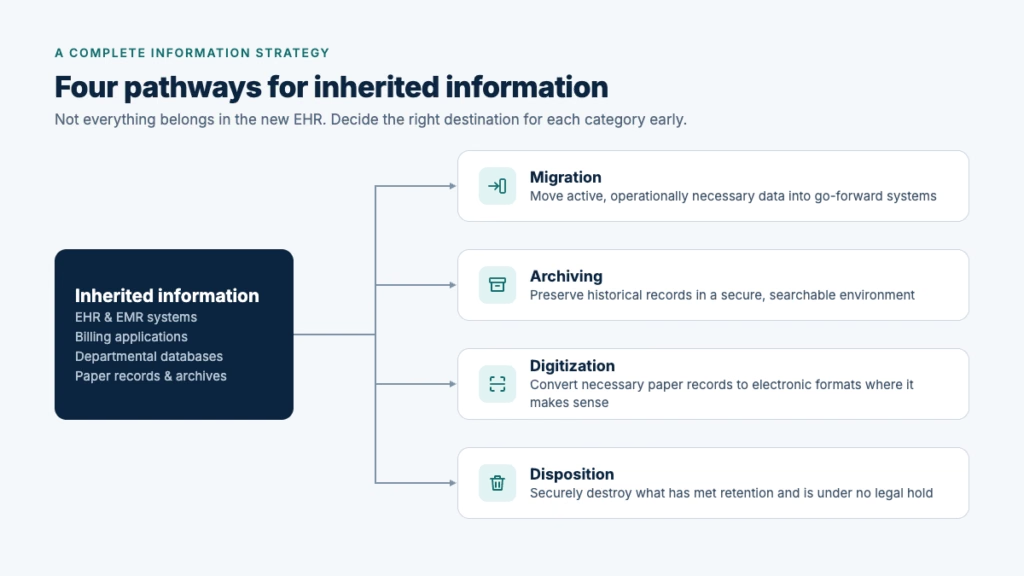
Establishing these pathways early can help streamline technology transitions while protecting the integrity, availability, and confidentiality of healthcare information.
Start the Information Management Conversation During Due Diligence
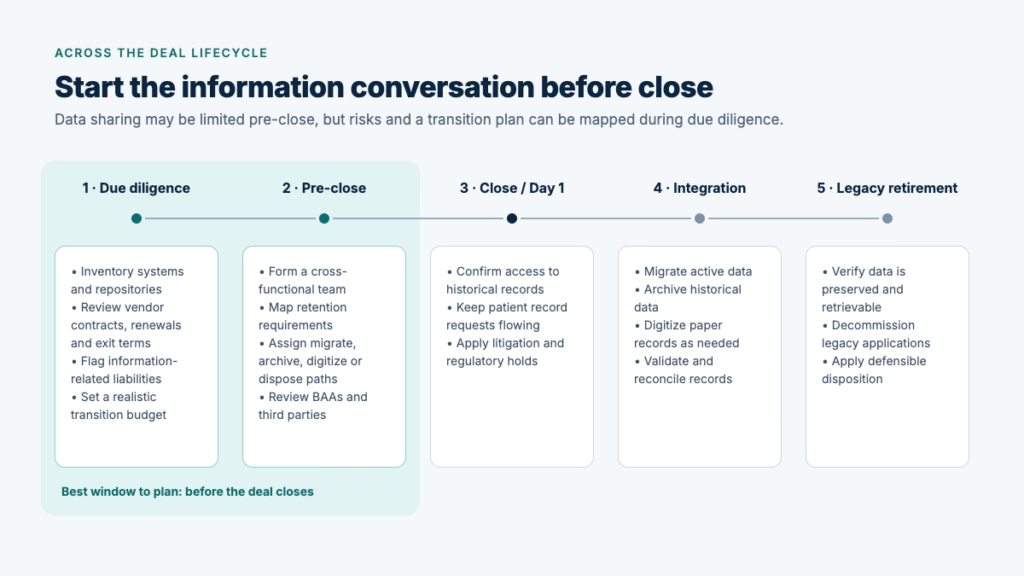
Information management planning should begin well before an acquisition or merger is finalized.
Although the actual transfer or disclosure of certain information may be restricted by privacy regulations, contractual obligations, and transaction-specific legal requirements, identifying risks and developing a transition strategy can often begin during the due diligence phase.
Early planning provides an opportunity to evaluate existing systems, understand contractual obligations, identify information-related liabilities, and establish realistic transition budgets.
Particular attention should be given to existing vendor agreements, including:
- Automatic contract renewal provisions
- Minimum contractual commitments
- Contract termination requirements
- Data ownership and portability provisions
- Data extraction fees
- Post-termination information availability
- Licensing requirements for read-only environments
- Vendor responsibilities during system transitions
Failure to identify these obligations early can result in unexpected expenses, delays, and continued dependence on legacy technology.
Healthcare organizations should also evaluate whether existing vendors have the capability and contractual responsibility to provide complete and usable information exports.
Identifying alternative extraction, preservation, and retrieval strategies before terminating vendor relationships can reduce the likelihood of disruptions during the transition.
Information Management Requires Cross-Functional Leadership
Although technology plays a central role in healthcare M&A, information management should not be treated exclusively as an IT responsibility.
The information inherited through a merger or acquisition serves multiple organizational functions, each with different requirements and priorities.
A comprehensive planning team should include representatives from:
- Executive leadership and M&A integration teams
- Information technology and cybersecurity
- Health Information Management (HIM)
- Compliance and privacy
- Legal and risk management
- Clinical leadership and informatics
- Revenue cycle management
- Finance and accounting
- Records and information management
- Operational and departmental leadership
Involving these stakeholders early helps ensure that decisions are made with consideration for the organization’s overall responsibilities rather than the requirements of a single department.
For example, information that may appear unnecessary from a technology perspective could remain essential for a patient records request, reimbursement dispute, regulatory investigation, or legal proceeding.
Seven Essential Questions for Healthcare M&A Readiness
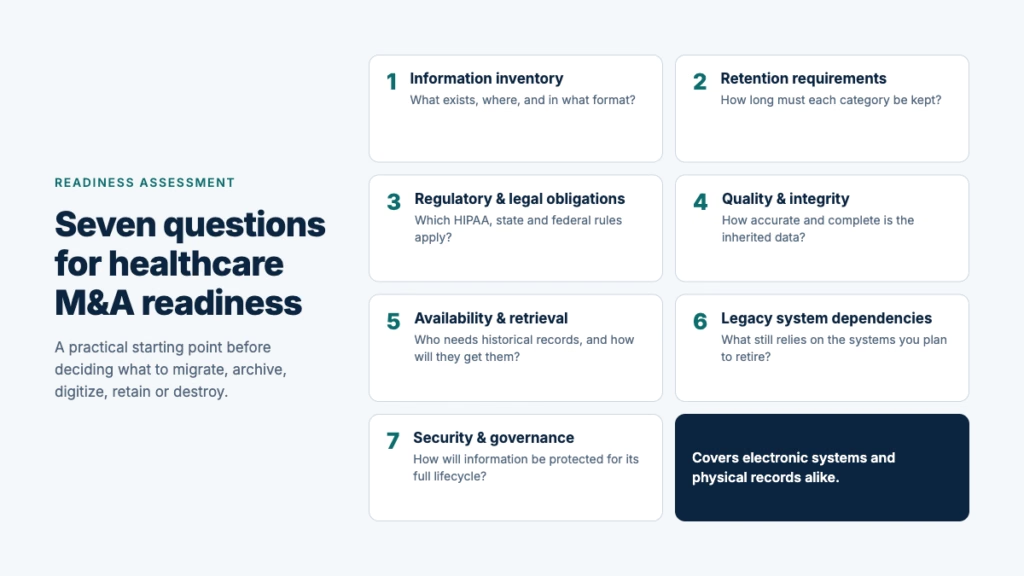
Before determining what information should be migrated, archived, digitized, retained, or destroyed, healthcare organizations should conduct a comprehensive information management readiness assessment.
The following seven areas provide a practical starting point.
1. Information Inventory
What information exists, where is it located, and in what format is it maintained?
Organizations should identify all relevant electronic and physical information repositories, including departmental systems and records maintained outside of primary enterprise platforms.
2. Records Retention Requirements
How long must each category of information be retained?
Retention requirements may vary based on federal and state regulations, organizational policies, record classifications, contractual obligations, and applicable legal holds.
Organizations should avoid assuming that a single retention schedule can be applied to every category of healthcare information.
3. Regulatory and Legal Obligations
What regulatory, privacy, and legal requirements must be addressed throughout the transition?
Healthcare organizations must evaluate applicable HIPAA requirements, state-specific privacy and records management regulations, federal requirements, and other relevant obligations governing the preservation, disclosure, and protection of information.
4. Information Quality and Integrity
How accurate, complete, and reliable is the information being inherited?
Legacy systems may contain duplicate records, inconsistent patient identifiers, incomplete documentation, outdated coding structures, and incompatible data formats.
These issues should be identified and addressed through appropriate validation and reconciliation processes.
5. Information Availability and Retrieval
Who needs historical information, how frequently is it required, and how will it be retrieved?
Clinical teams, HIM departments, revenue cycle personnel, legal teams, and other authorized users may continue to require historical information for many years following a transaction.
Preserving information without establishing an effective retrieval process can create significant operational challenges.
6. Legacy System Dependencies
Which applications, interfaces, and business processes continue to depend on existing systems?
Before retiring an application, organizations should identify dependencies that could affect patient care, billing, reporting, laboratory services, imaging, or other essential operations.
7. Security and Information Governance
How will information be protected throughout its remaining lifecycle?
Organizations should establish appropriate security controls, role-based permissions, authentication requirements, audit capabilities, retention policies, and procedures for authorized information disposition.
These requirements should extend to both electronic information and physical records.
Frequently Overlooked Information Management Risks
Even well-planned healthcare mergers and acquisitions can encounter information management challenges that were not identified during initial due diligence.
Several areas deserve particular attention.
Patient Rights and Requests for Historical Records
A merger, acquisition, or system retirement does not eliminate applicable obligations to provide patients and their authorized representatives with their medical information.
Patients may request historical records years after the original system has been retired.
Healthcare organizations must establish reliable procedures for locating, retrieving, and releasing information in accordance with applicable patient access requirements, including HIPAA and federal information-blocking rules where applicable.
Simply preserving information is not sufficient if it cannot be located and provided when required.
Business Associate Agreements and Third-Party Relationships
Healthcare transactions frequently involve transferring responsibilities associated with third-party service providers.
Existing Business Associate Agreements (BAAs) should be reviewed to determine whether they remain appropriate following the transaction.
Organizations must also ensure that third parties handling protected health information have the necessary agreements, safeguards, and responsibilities in place before undertaking activities that require them.
Audit Trails and Chain of Custody
Maintaining the integrity and history of information is essential for regulatory compliance, legal defensibility, and organizational accountability.
Where required, organizations should preserve relevant audit logs, record histories, metadata, and documentation demonstrating how information was collected, transferred, maintained, and protected.
Information preservation strategies should account for more than the underlying documents or clinical data. The supporting information that establishes authenticity and accountability may be equally important.
Specialized and Sensitive Healthcare Records
Certain categories of healthcare information may be subject to additional retention, confidentiality, or disclosure requirements.
Examples include:
- Behavioral and mental health records
- Substance use disorder treatment records subject to 42 CFR Part 2
- Pediatric and minor patient records
- HIV-related information
- Genetic testing information
- Records subject to litigation or regulatory investigations
These information categories should be evaluated individually rather than automatically subjected to a uniform retention and disclosure policy.
Unidentified and Departmental Information Repositories
Not all healthcare information resides within an organization’s primary EHR.
Departments may maintain their own databases, spreadsheets, shared network folders, imaging platforms, laboratory applications, practice management systems, and physical filing systems.
These decentralized repositories are frequently overlooked during information inventories.
A comprehensive assessment should include discussions with departmental leadership to identify information that may not appear in the organization’s official application or records inventory.
Physical Medical and Business Records
Despite the widespread adoption of electronic healthcare systems, many organizations continue to maintain significant volumes of physical documentation.
These records may include historical patient charts, administrative documents, financial records, personnel files, and other regulated information.
During an acquisition, organizations should determine:
- Where physical records are stored
- Who is responsible for their management
- Whether existing inventories are accurate
- Which records require continued retention
- Whether digitization is operationally or financially appropriate
- How authorized individuals will retrieve records
- Which records are eligible for secure destruction
Physical records should receive the same level of governance and strategic consideration as electronic information.
Establishing a Sustainable Information Management Environment
The objective of healthcare information management during M&A should extend beyond the immediate technology integration project.
The long-term goal is to establish an environment in which information remains secure, appropriately governed, accessible to authorized individuals, and manageable throughout its required lifecycle.
A well-defined information management strategy can help healthcare organizations:
- Reduce dependence on outdated and redundant technology
- Lower long-term information management expenses
- Improve historical records retrieval
- Support continuity of patient care
- Strengthen regulatory compliance and audit readiness
- Reduce unnecessary information retention
- Improve information security and accountability
- Support future acquisitions and organizational growth
Legacy system retirement should occur only after the organization has verified that required information has been successfully preserved, validated, and made available through an appropriate alternative environment.
Equally important, information should not be retained indefinitely simply because it exists. Organizations should implement defensible disposition practices that align with established retention schedules, applicable regulations, and legal obligations.
Information Management Is an Essential Component of M&A Strategy
Healthcare mergers and acquisitions represent significant opportunities for organizational growth, operational improvement, and expanded patient services.
However, realizing these benefits requires more than consolidating facilities, integrating technology, and aligning business operations.
It requires a disciplined approach to managing the information that supports those operations.
At Global Document Services, we believe information management should be viewed as a strategic component of healthcare M&A, rather than simply an administrative or technology-related task.
By addressing information inventories, records retention, data migration, historical archiving, document digitization, security, and information governance during the earliest stages of a transaction, healthcare organizations can make more informed decisions, reduce unnecessary expenses, and minimize avoidable risks.
The most effective time to develop an information management strategy is before the transaction closes—not after legacy systems, contractual obligations, and fragmented information environments become operational challenges.
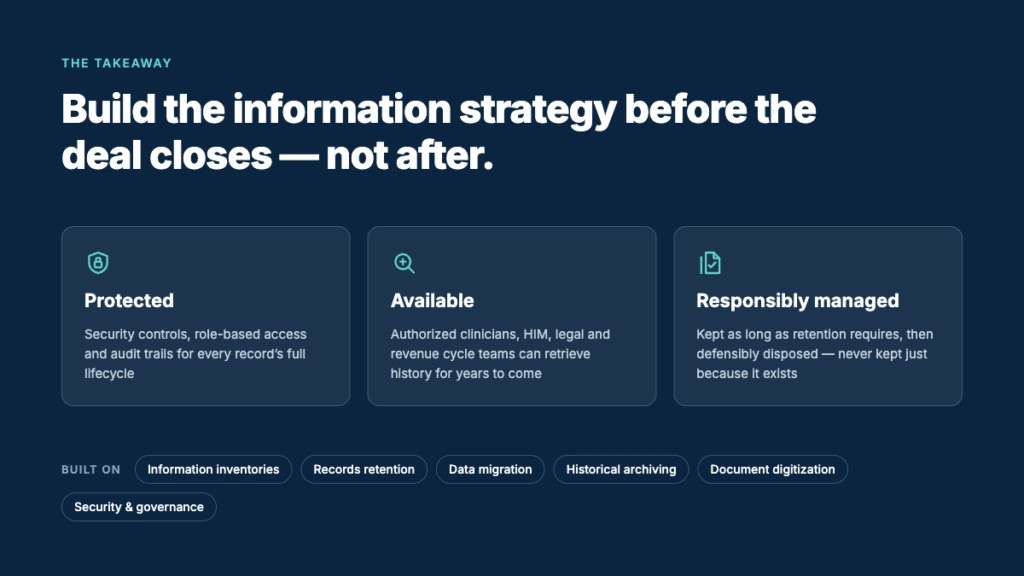
Successful healthcare integration is not simply about bringing organizations together. It is also about ensuring that the information entrusted to those organizations remains protected, available, and responsibly managed throughout the transition and beyond.
An educational perspective from Global Document Services on healthcare information management, records governance, and mergers and acquisitions.


